

 English
 русский
 Español
 Português
 عربى
 italiano

OEM Pet Nail Clipper Sourcing Guide: Steel Blades, MOQs & Private Label
Content
- 1 What OEM Really Means for a Pet Nail Clipper
- 2 Blade Steel and Edge Geometry Decide Your Return Rate
- 3 Mechanism, Spring and Pivot: Where Cheap Clippers Fail
- 4 Build a Range, Not a Single SKU
- 5 Private Label Checklist Before You Approve Artwork
- 6 QC Points to Agree Before the First Shipment
- 7 FAQ: OEM Pet Nail Clipper Orders
- 8 The Short Version
A Dutch pet brand once rejected 6,000 nail clippers because of a spring, not a blade. The jaws looked perfect on the bench. After 3,000 open-close cycles the tips no longer met, and a clipper that leaves a ragged nail edge comes straight back off the shelf.
That failure shows why experienced buyers lock down three things before signing an OEM pet nail clipper contract: blade alloy and hardness, jaw alignment tolerance, and spring fatigue life. Logo, colour and box artwork are easy variables a supplier can change in a week. The mechanics cannot be changed once the tooling is cut.
This guide covers what each specification actually controls, where low-cost clippers fail first, and how to structure a first order so you are not paying for tooling you cannot sell.
What OEM Really Means for a Pet Nail Clipper
In this category "OEM" is used loosely. It helps to separate three levels, because each carries a very different tooling cost and minimum order quantity.
- Private label: an existing mould, your logo and your packaging. No tooling fee, lowest MOQ, fastest sampling turnaround.
- OEM: your handle shape, colour, blade specification and packaging, built on shared or dedicated tooling. You pay for the difference between standard and custom.
- Full ODM: new dies, a new spring specification and a new retail structure, developed with the supplier's design engineers.
Practical sequence: launch private label on the fastest-turning size, prove sell-through, then move your best seller to full OEM. Cutting new tooling before you know which size sells is the most common way importers tie up cash for a year.
A typical clipper is four parts — a PP or ABS body, a TPR over-moulded grip, a stainless blade set and a stainless spring. Only the first two are branding decisions.
Blade Steel and Edge Geometry Decide Your Return Rate
Ask three questions in every quotation round: which alloy, what hardness window, and can I see the heat-treatment record? "Stainless steel" on its own says nothing. 420J2 at 47 HRC and 440C at 57 HRC are both stainless steel, and they behave like different products on the shelf.
| Blade material | Typical hardness | Edge retention | Best fit | Watch out for |
|---|---|---|---|---|
| 3Cr13 / 420J2 stainless | 48–52 HRC | Moderate | Entry-level clippers and multipacks | Edges roll when hardness drops below 46 HRC |
| 4Cr14 / 430 stainless | 52–54 HRC | Good | Mid-tier private label lines | Heat treatment varies batch to batch |
| 440C stainless | 56–58 HRC | Excellent | Premium grooming ranges | Micro-chipping if over-hardened |
| Ceramic (zirconia) | Very high | Excellent on thin nails | Cat and small-breed clippers | Chips on thick nails if the blade is not replaceable |
| Coated carbon steel | 58–60 HRC | Very good | Thick, hard nails | Coating must survive humidity in transit |
Hardness is read on the Rockwell C scale. A 2–3 HRC spread inside one batch is normal; a 6 HRC spread means heat treatment is out of control, and buyers see the result as chipping on some units and rolling on others.
Geometry matters as much as alloy. Scissor-type clippers usually carry a 20–25° bevel per side; guillotine and plier types shear rather than slice, so the cutting opening becomes the number to specify — 4–6 mm for cats and small breeds, 8–10 mm for large dogs, with 1.8–2.0 mm blade stock instead of the 1.2–1.5 mm used on small models.
A proven stainless clipper in a standard size is the lowest-risk first SKU: the mould exists, the blade spec is documented, and only branding and packaging need to change.
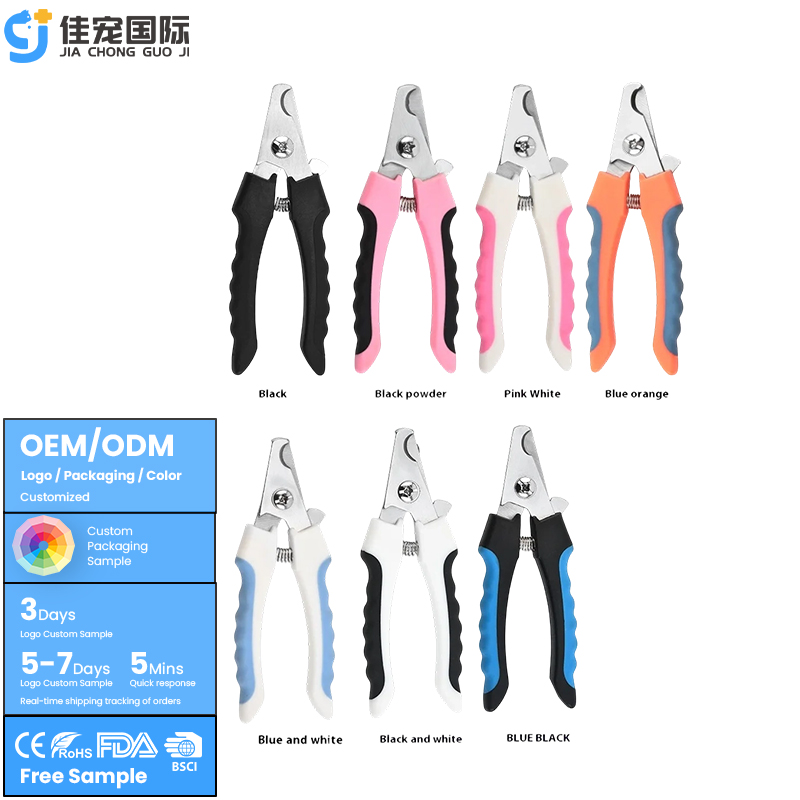 Standard Stainless Steel Pet Nail Clipper in Two SizesA standard stainless steel clipper for pet nail trimming, offered in large and small sizes with a straight blade and locking safety mechanism.View Product →
Mechanism, Spring and Pivot: Where Cheap Clippers Fail
With the blade settled, risk moves to the moving parts. Four points are worth writing into the specification.
- Spring: 304 stainless wire, typically 0.8–1.0 mm, with a documented cycle test. 5,000 open-close cycles is the floor; 10,000 suits brands selling to professional groomers.
- Pivot: riveted pivots are cheaper and not serviceable. A screw pivot can be re-tightened by the end user and is worth the small premium for groomer-facing ranges.
- Safety stop: the stop that prevents over-closing should be metal or sit on a reinforced boss. A stop moulded into thin PP is a familiar breakage point.
- Grip: TPR over-moulds can lift after repeated contact with hand sanitiser or hot water. If your market cleans tools that way, ask for an adhesion test.
Electric models change the mechanism entirely: a rotary grinding head replaces the blade set, so the specification shifts to motor speed, spindle run-out, and the grit and replaceability of the grinding wheel.
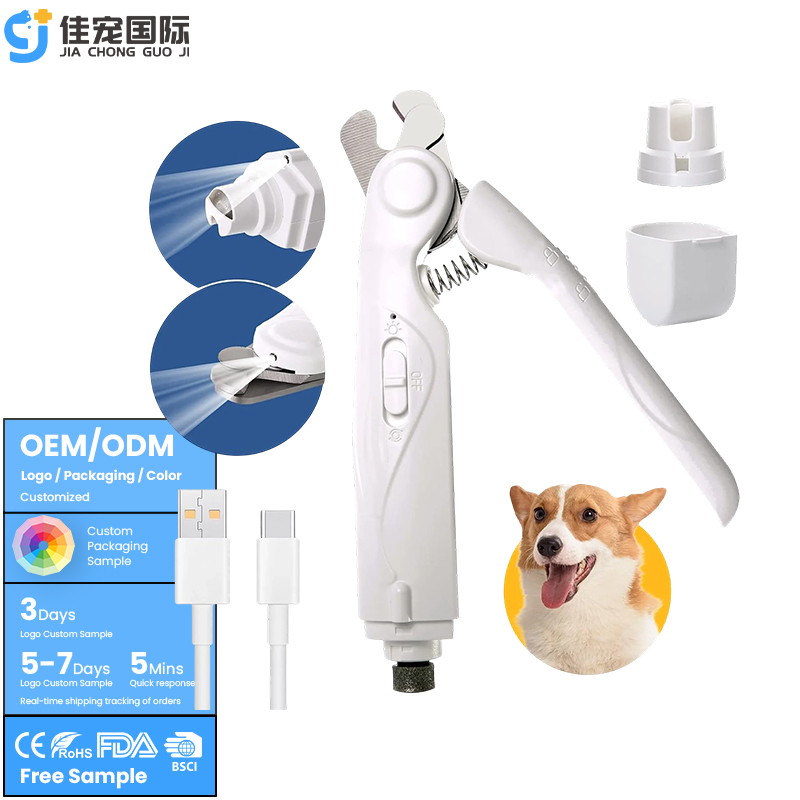 2-in-1 Electric Pet Nail Clipper with LED LightA two-in-one grooming tool combining a cutting blade and grinding wheel, with built-in LED light, viewing window, and limiter for controlled trimming.View Product →
Build a Range, Not a Single SKU
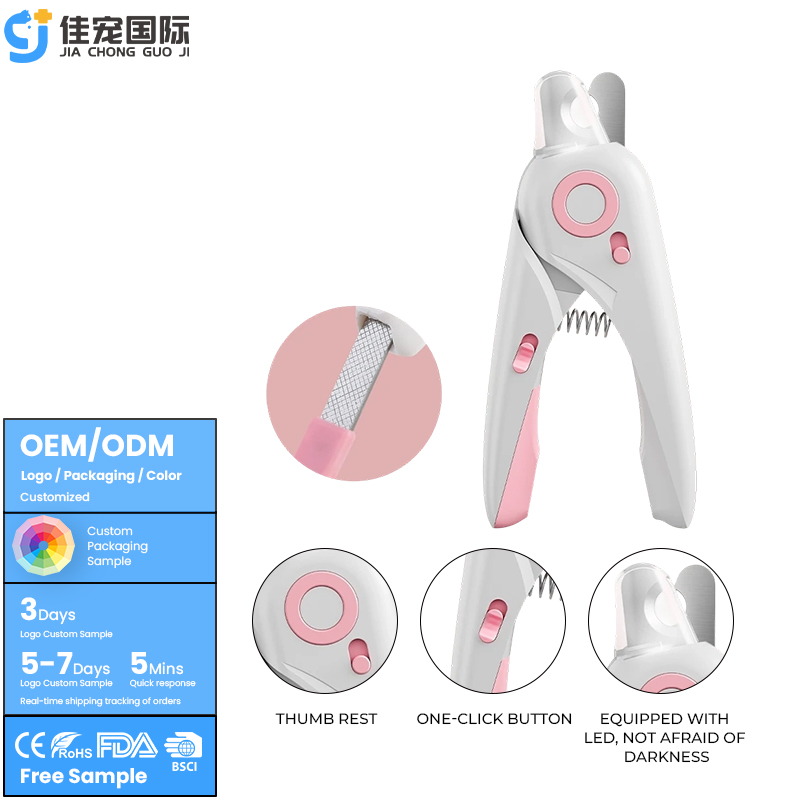
Nail care sells as a family. Most successful private label programmes launch three items together: a standard clipper for medium and large dogs, a small clipper for cats and toy breeds, and one premium item — LED or electric — as the shelf statement.
Small sizes carry the volume
Cat owners replace clippers more often than large-dog owners, and small-breed owners are among the fastest-growing grooming segments in most Western markets. A small clipper needs a shorter jaw, a lighter spring and a total weight closer to 45 g. Because it can often share the same blade and spring specification as its larger sibling, adding the size rarely means new tooling for anything except the body mould.
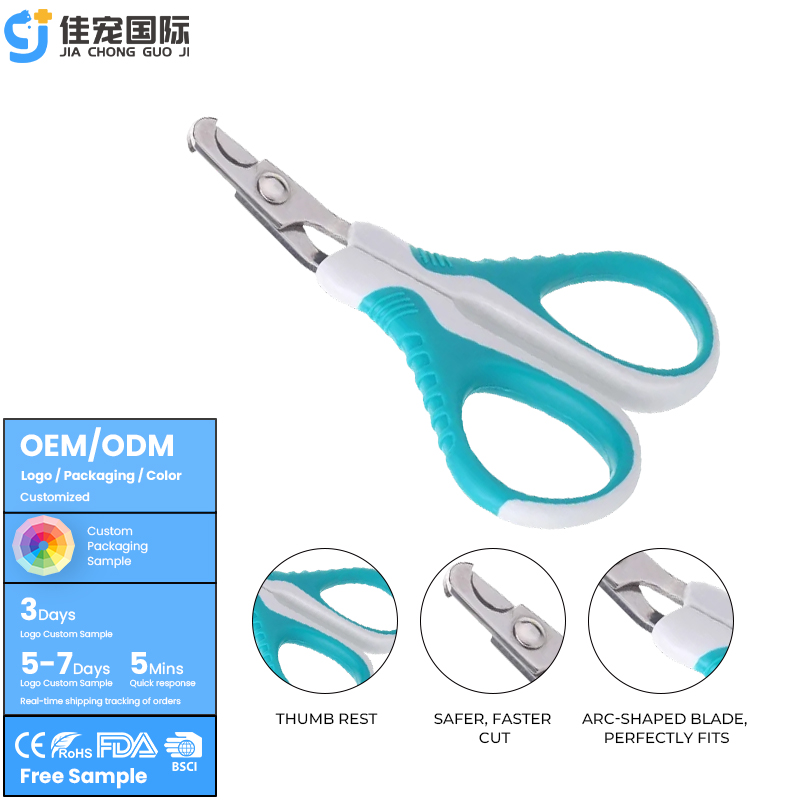 Small Pet Nail Clipper for Puppies and Toy BreedsA compact stainless steel clipper for small pets and puppies, featuring rounded safety-head blades and an anti-slip design for secure trimming.View Product →
The same logic makes clippers the natural add-on in grooming kits. A nail clipper inside a 6-in-1 or 10-in-1 set raises average order value without adding a new production process.
Private Label Checklist Before You Approve Artwork
- Logo method: laser etching on stainless steel is permanent; pad printing on TPR wears away within months and shows up in reviews rather than in returns.
- Colour: Pantone matching on PP is close but never exact. Agree a tolerance and approve a physical sample, not a screen proof.
- Packaging: blister with a hang tab, kraft box or printed colour box. Confirm barcodes, warning icons and language versions for every destination market.
- MOQ drivers: colour and packaging move the MOQ far more than blade specification. Ask for the MOQ per colour, not per model.
- Compliance paperwork: request material declarations for handle plastics and coatings for the markets you ship to, and keep a copy per order.
- Golden sample: sign and seal one approved unit and keep a counterpart. Disputes disappear when both sides hold a reference part.
QC Points to Agree Before the First Shipment
A workable default for grooming tools is AQL 1.5 for major defects and 4.0 for minor ones. What matters more is which checks are performed, and how often.
- Incoming material: alloy certificate plus hardness spot checks on every heat lot.
- In-process: jaw alignment gauge and spring tension sampling each shift.
- Finished goods: full open-close function test on premium lines, cycle sampling on standard lines.
- Coating: salt-spray check on plated or coated blades where humidity is a shipping risk.
Capacity matters too, because a good specification is worth nothing if it cannot be repeated at volume. Our production runs across 18 lines in a 10,000 m² plant with eight dedicated QC inspectors — see the factory page for the setup.
FAQ: OEM Pet Nail Clipper Orders
What is a realistic MOQ for a private label clipper?
The MOQ is usually set by colour and packaging rather than by the blade. One colour in a standard box is the lowest entry point; each additional colour adds a separate production run, so agree the MOQ per colour before designing a five-colour shelf set.
Can I see my logo on a sample before committing?
Yes. Laser-etched samples are the normal route, and they are worth the waiting time: etching depth and placement on a curved handle are hard to judge from a digital mock-up.
Which blade suits large dogs with thick nails?
440C stainless at 56–58 HRC, or a coated carbon steel. Check for micro-chipping on the finished edge, and confirm the cutting opening is at least 8 mm — an undersized opening forces the user to twist the nail.
Can the clipper be packed with other grooming items?
Yes. Clippers ship inside comb, brush and grooming sets routinely, which spreads freight cost per unit and gives retail buyers a higher-value SKU from the same order.
The Short Version
Decide the alloy and hardness window first, specify spring cycles and pivot type second, and treat colour and packaging as the last decisions rather than the first. Then approve one sealed sample and scale.
To test this on a real quote, send your target sizes, blade preference and artwork through the contact page and ask for a branded sample before any tooling is discussed.

Since its founding in 2009, Jia Chong has devoted itself to the pet-care sector, with a “people-first, pet-embrace” philosophy, delivering professional, high-quality, full-line one-stop solutions for pet families worldwide.
-
 No. 90, Fengming Road, South District, Economic Open Zone, Yuyao City, Zhejiang Province, China
-
 +86-152 5827 1677
-
 info@nbpetsfamily.com
Copyright © Ningbo Jia Chong International Trade Co., Ltd. All Rights Reserved. OEM/ODM Pet Accessories Manufacturer Pet Products Factory
