

 English
 русский
 Español
 Português
 عربى
 italiano

Custom Pet Smart Water Dispenser: OEM & ODM Sourcing Guide for Global Buyers
Content
If you are sourcing a custom pet smart water dispenser, two numbers settle most of the outcome before a single logo is printed: the reservoir volume and the pump's measured noise level. Housing colour, badge finish and gift-box artwork can all be adjusted late with little risk. A pump that hums at 2 a.m., or a tank that needs refilling every second day, cannot be fixed after the container has sailed.
The short answer: plan a 3L model for single-cat apartments, desk-gift channels and entry price bands; a 4L model for multi-pet homes and larger breeds; and treat the pump, the filtration choice and cleaning access as the three points where low-cost builds fail first. What follows is the capacity math, the specification lines worth locking before tooling, the customisation levers that matter in OEM and ODM work, and the inspection steps that keep returns down.
Capacity Math: What 3L and 4L Really Deliver at Home
Hydration guidance for cats and small dogs usually sits around 50 to 60 ml of water per kilogram of body weight per day. A 4 kg cat therefore needs roughly 200-240 ml daily, and a 6 kg cat closer to 300-360 ml. A 3L reservoir looks like a two-week supply on paper, but evaporation, splashing and a second pet eat into that figure. In practice, expect a 3L unit to serve one cat for four to six days and two cats for two to three; a 4L unit buys roughly a third more time between refills.
3L Smart Water Dispenser: The Volume SKU
Three litres fits apartment counters, ships cheaply and lands on the price point that gift and e-commerce channels move in volume. It is the sensible default when the end buyer owns one cat, lives in a smaller home, and replaces the unit every couple of years rather than treating it as furniture.
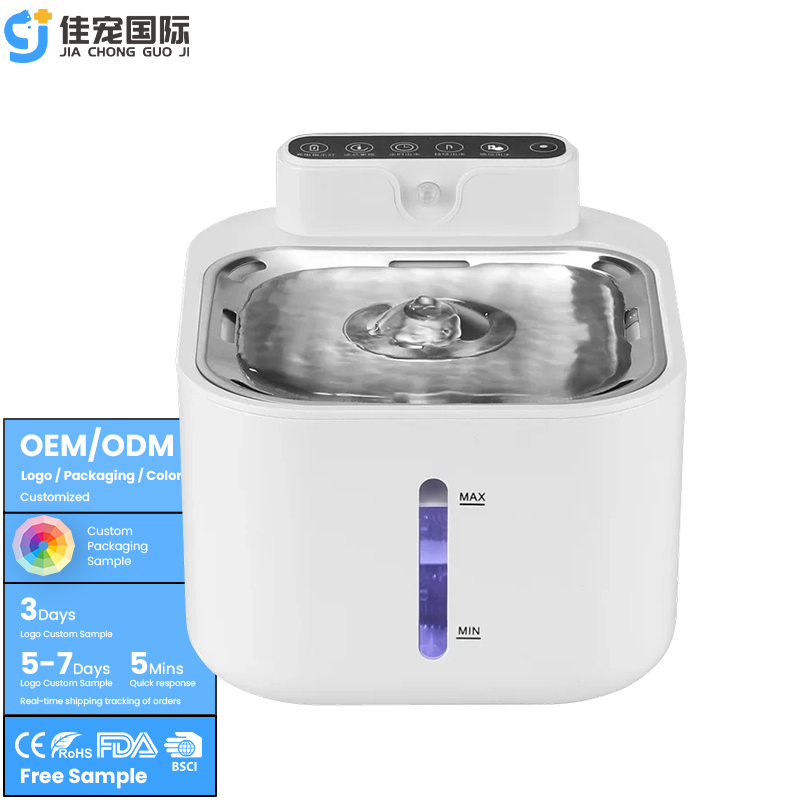 3L Pet Smart Water Dispenser with App Control and HeatingA 3L smart dispenser for smaller homes, with wireless app control, filtration, and optional 28°C heating.View Product →
4L Smart Water Dispenser: The Household SKU
Four litres suits two-cat homes, a small dog sharing the bowl, and markets where owners leave for the weekend. The footprint grows by only a few centimetres, but refill interval is the feature buyers mention most often in reviews, which usually makes this the model to push in premium listings.
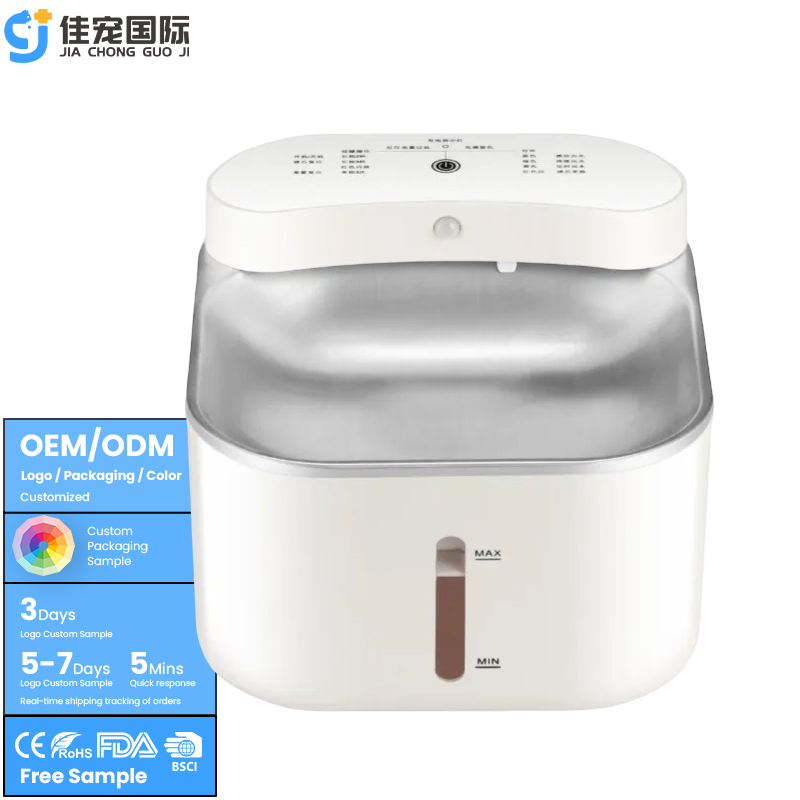 4L Pet Smart Water Dispenser with Wireless App MonitoringLarger 4L model for multi-pet homes, featuring app monitoring, five-stage filtration, and 28°C constant-temperature heating.View Product →
Specification Lines That Predict Returns
Pump and noise
Ask for the measured sound level at one metre in normal running mode, not a marketing range. Anything above a quiet bedroom hum becomes a complaint in open-plan flats. Specify a low-water cut-off and confirm it is actually tested, because impeller bearings fail fastest when a pump runs dry.
Filter or filterless
Filterless designs circulate water and separate the clean and dirty sections, which takes a consumable out of the owner's monthly cost. Filtered designs polish the water and create an accessory revenue stream, but they add a purchase the buyer must remember. Decide before tooling, because the tank geometry differs between the two approaches.
Cleaning access and materials
The biggest driver of one-star reviews in this category is a tank that cannot be fully opened and scrubbed. Check that the reservoir separates without tools, that the pump lifts out, and that every wetted part is food-grade with documentation behind it rather than a claim on a spec sheet.
Power and market fit
Voltage, plug type and cable length are cheap to vary and expensive to correct after shipping. Confirm the adapter standard for each destination market before the carton artwork is finalised.
| Item | Options in this category | Risk if left vague |
|---|---|---|
| Reservoir volume | 3L or 4L | Wrong size for the target household, slow sell-through |
| Pump noise | Measured level at 1 m | Noise complaints and poor review scores |
| Filtration | Filterless circulation or replaceable cartridge | Running-cost objections, or lost accessory sales |
| Low-water protection | Cut-off sensor or none | Pump burnout and warranty claims |
| Cleaning access | Tool-free tank opening | Hygiene complaints and mould growth |
| Materials | Food-grade wetted parts, documented | Regulatory hold-ups at customs |
| Power | Market-specific plug and voltage | Unsellable stock in the destination country |
What "Custom" Actually Covers in an OEM or ODM Order
In this product family, customisation usually extends well past a printed logo. Buyers typically have room to change:
- Reservoir capacity and tank shape, using existing 3L and 4L tooling
- Housing colour, surface finish and logo method, including embossed badges
- Controller behaviour: scheduled water changes, circulation cycles, indicator logic
- Filtration configuration and spare-cartridge packaging
- Plug type, voltage and cable length for each destination market
- Retail packaging, manuals and inserts in the target language
- Spare-part kits for after-sales support
Ningbo Jia Chong has manufactured pet care products since 2009 and runs a 10,000 sqm plant with 18 production lines, five designers and six R&D engineers. Industrial design, electronics and moulds sit in the same building, which is what makes ODM work practical rather than theoretical, and the company already exports to more than 40 countries. Two negotiation points are worth raising early: ask for the minimum order per SKU rather than per order, since colour variants multiply it, and settle three-year spare-part availability at the quotation stage.
Quality Control: Where Cheap Fountains Fail
Most returns in this category trace back to a handful of repeatable faults. Eight dedicated quality inspectors on the line can catch them; a trading office that never opens a carton cannot. The checks worth writing into the purchase order are:
- Tank seam and pump housing leak test, by unit rather than by sample
- Continuous pump run with noise measured at one metre, before and after break-in
- Flow-rate stability at low water level, plus a functional test of the cut-off
- Material documentation for every wetted component, matched to the batch
- Controller function test covering scheduled cycles and indicator behaviour
- Plug and adapter conformity for each destination market
- Packed-carton drop test to confirm the retail box survives the last mile
Buyers who want to see the setup before committing can review the plant's scale, line count and staffing on the factory and quality pages. That matters most on a first order, where a short sampling delay is far cheaper than a container of noisy pumps.
Hydration Away From the Wall Socket
A dispenser needs mains power, which makes it useless in a carrier at the vet or on a road trip. Buyers who list a 3L or 4L unit usually pair it with a portable bottle on the same page: the 3-in-1 format carries water and a drinking surface in one shell, adds an easy upsell, and covers the one scenario a fountain cannot.
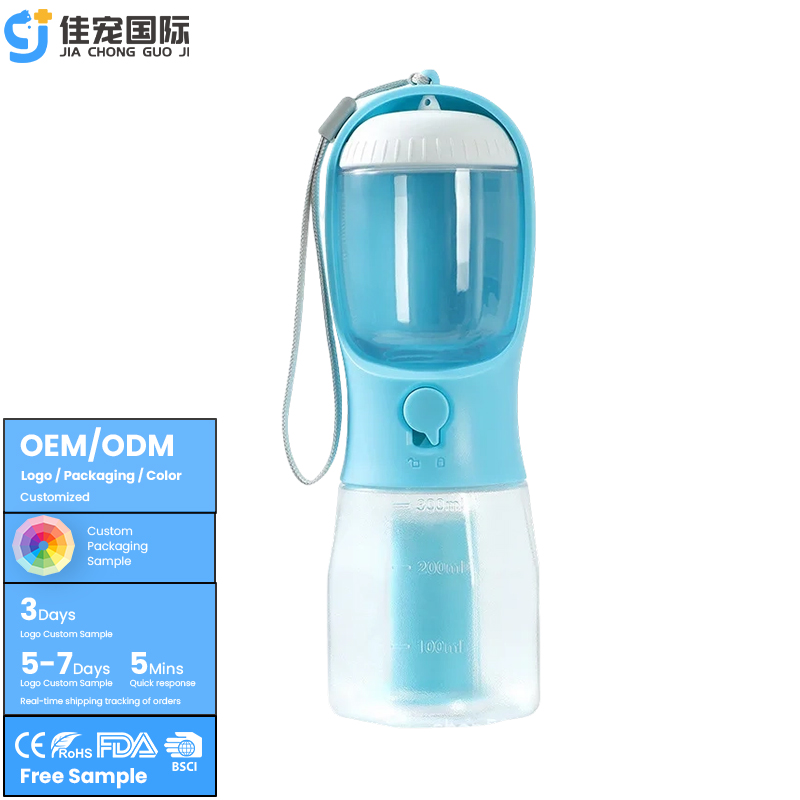 3-in-1 Portable Pet Water Bottle with Food CupPortable ABS+PC bottle combining water, food cup, and trash bag dispenser for walks; pairs with mains-powered fountains.View Product →
Frequently Asked Questions
How long does a 3L dispenser last with two cats?
Roughly two to three days in a normal household. Cats drink more in warm weather and when eating dry food, and evaporation takes its share, so treat the printed capacity as an upper bound rather than a schedule.
Do smart dispensers need a filter?
No. Filterless designs circulate water and separate the clean and dirty sections, which removes the recurring cartridge cost. Filtered models trade a higher running cost for finer water polishing and a repeat accessory sale.
What should be tested on the first article?
Noise at one metre, flow rate at low water level, the low-water cut-off, tank sealing after a full drain-and-refill cycle, and plug conformity for the destination market. Ask for the test data in writing alongside the sample.
From Specification to First Sample
A custom pet smart water dispenser is a manageable project once the size, the pump and the filtration choice are settled. Decide which household you are selling to, lock the lines in the checklist above, and inspect a sample before the carton artwork is finished. If you have a target price and a market, send the specification through and the team can confirm tooling, spare parts and lead time for the first order.
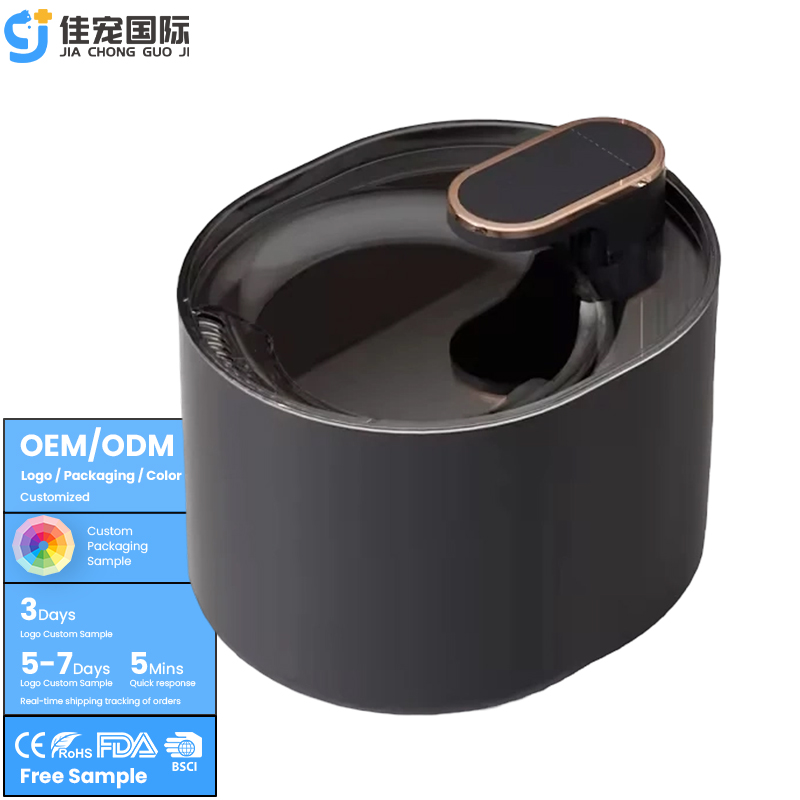

Since its founding in 2009, Jia Chong has devoted itself to the pet-care sector, with a “people-first, pet-embrace” philosophy, delivering professional, high-quality, full-line one-stop solutions for pet families worldwide.
-
 No. 90, Fengming Road, South District, Economic Open Zone, Yuyao City, Zhejiang Province, China
-
 +86-152 5827 1677
-
 info@nbpetsfamily.com
Copyright © Ningbo Jia Chong International Trade Co., Ltd. All Rights Reserved. OEM/ODM Pet Accessories Manufacturer Pet Products Factory
