

 English
 русский
 Español
 Português
 عربى
عربى italiano
OEM Cat Litter Box Sourcing Guide: Sizes, Customization, Factory Checks
Content
- 1 What OEM Covers on a Cat Litter Box, and What It Does Not
- 2 Three Platforms Cover Most of the Market
- 3 Enclosed or Open-Top? The Choice That Shows Up in Your Reviews
- 4 Multi-Cat Homes and the Larger Enclosed Body
- 5 Spec Sheet Items to Lock Before You Ask for a Quote
- 6 Factory Checks: What a Manufacturing Partner Should Show You
- 7 FAQ: OEM Cat Litter Box Orders
Picture the moment a container of automatic cat litter boxes reaches your warehouse: the units cycle, the panels light up, but the logo sits three millimetres off centre, the drawer seal is missing, and the carton carries the wrong model code. None of that is a design failure. It is a specification failure, and it gets fixed at the factory, not in the marketing budget.
The short answer first: when you buy an OEM cat litter box, you are not buying a plastic box. You are buying drawings, a shared platform or a tool, an electronics package, a carton spec and an inspection routine, plus a supplier able to hold all five steady across repeat orders. Capacity and enclosure style are what most buyers customize; body geometry and the drive assembly are where the real engineering sits.
What OEM Covers on a Cat Litter Box, and What It Does Not
Three sourcing models get mixed into one quotation, and mixing them is the fastest way to misread a price.
OEM, ODM and private label are three different conversations
Private label is the lightest route: an existing body, your logo on the panel, your artwork on the carton. OEM goes a layer deeper, where you specify housing colour, panel language and icons, plug type and packaging inserts. ODM means the supplier develops the unit itself, usually from your brief, with its own design and engineering team.
What is easy to change, and what is not
- Straightforward: colour, logo application, panel language, plug and voltage, carton print, manual wording.
- Slower but possible: drawer gasket material, litter screen pattern, motor grade, button layout.
- Effectively a new project: mould geometry, the frame carrying the drum, and sensor placement.
Ask which category each request falls into before you negotiate. A supplier that treats a new mould and a new carton as the same kind of favour will surprise you later.
Three Platforms Cover Most of the Market
In practice, three bodies answer most enquiries: a 65-litre enclosed unit, a 76-litre enclosed unit and a 76-litre open-top unit. The litre figure describes working capacity, not footprint. Two boxes with the same capacity can still need very different floor space, so confirm length, width and height before the carton is designed.
| Platform | Stated capacity | Enclosure style | Typical household | Buyer note |
|---|---|---|---|---|
| 65L automatic | 65 L | Enclosed | One to two cats | Smaller carton, lower landed cost, fits entry and mid-tier listings |
| 76L automatic | 76 L | Enclosed | Two to three cats | Higher price point, larger freight cube |
| 76L open | 76 L | Open-top | One to three cats | Easy acceptance for cats new to automation, more litter scatter |
The 65-litre enclosed body is the workhorse of a first OEM order. It ships economically, fits standard retail shelving, and lets you test your brand, panel wording and carton artwork before committing to a bigger unit.
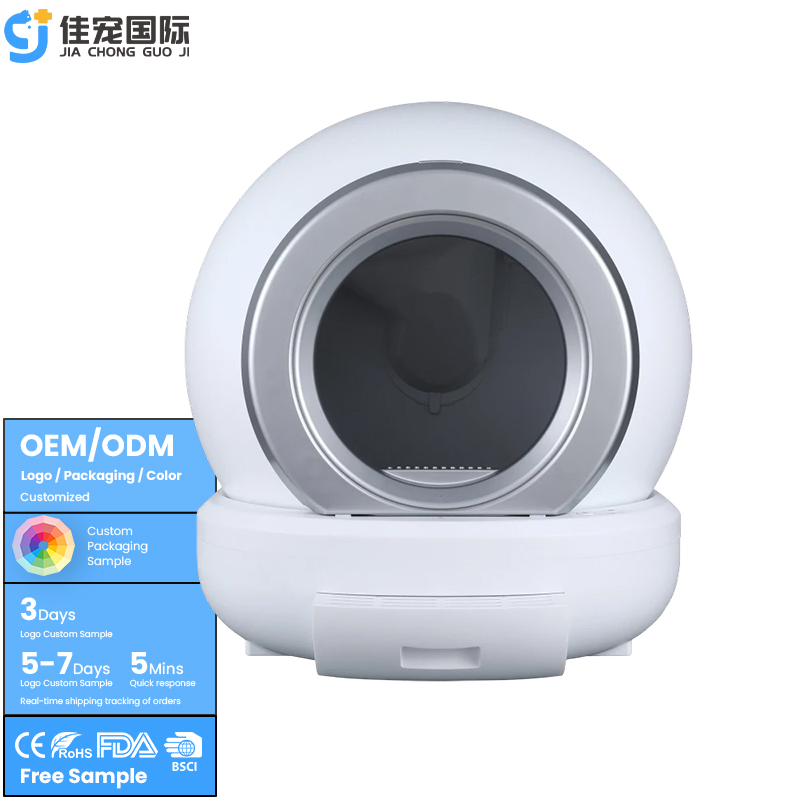 65L Automatic Cat Litter Box with App ControlEnclosed 65L self-scooping unit with app monitoring and sensor safety, suited to first OEM orders and retail trials before scaling up.View Product →
Whatever you pick, never print a capacity you cannot defend. If a buyer measures the drum and finds four litres missing, the review writes itself.
Enclosed or Open-Top? The Choice That Shows Up in Your Reviews
Enclosure style is a behaviour question, not a styling preference. Cats that have never used an automatic box often accept an open-top unit on day one, because there is no covered entrance to negotiate. That single fact reduces first-week returns, which is why open-top units sell well where automatic litter boxes are still new.
The trade-off is litter tracking. With no hood, cats exit with more granules on their paws, so an open-top unit needs a mat or a higher tray lip, and your product photos should show one. Enclosed units contain scatter and odour better and suit apartments, but a nervous cat may avoid them, so make sure the hood can be removed for the first weeks.
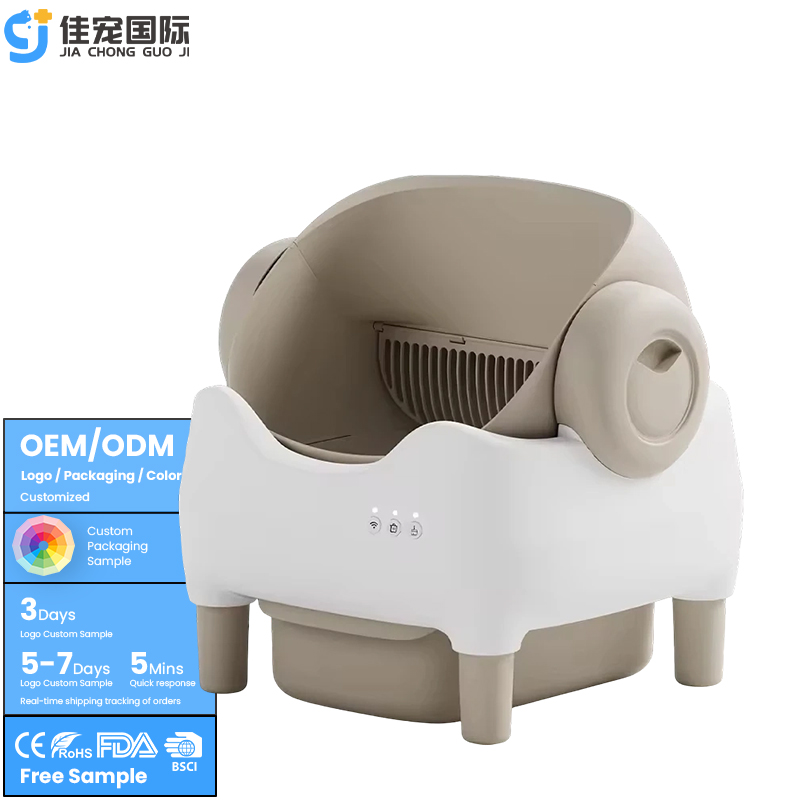 76L Open Automatic Cat Litter Box with AppOpen 76L automatic box with app control and anti-pinch sensors, reducing adaptation time for cats while requiring mats for litter tracking.View Product →
Three questions about your market usually settle the decision: how many cats per household, how much floor space buyers have, and whether the box sits against a wall or under a shelf.
Multi-Cat Homes and the Larger Enclosed Body
Once a household has three cats, capacity stops being a marketing number and becomes a cleaning-frequency problem. A larger enclosed body means fewer cycles per day, less drawer emptying and a calmer ownership experience, which is exactly the segment that leaves positive reviews and reorders.
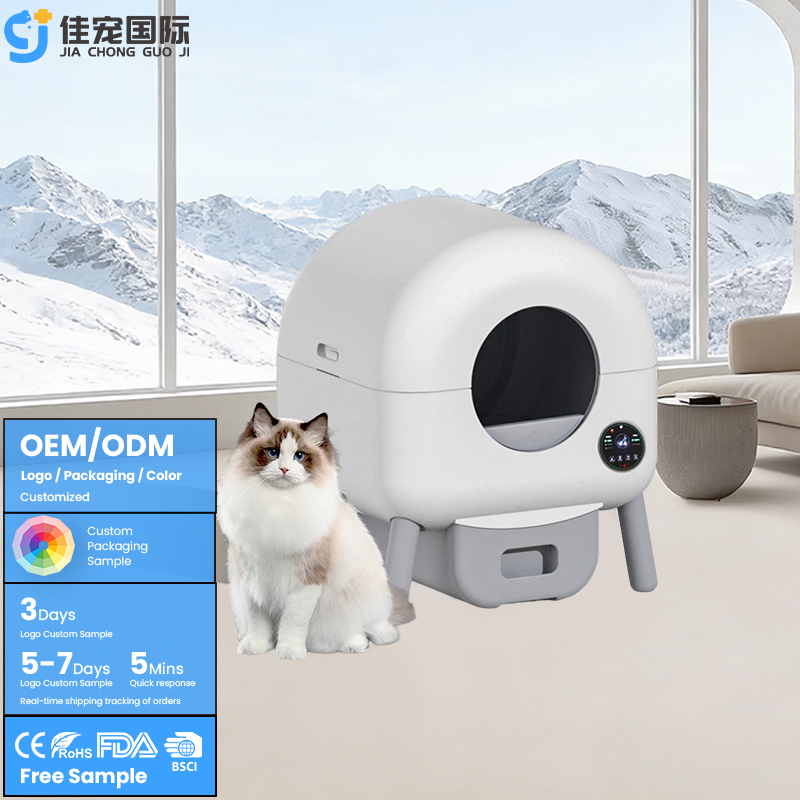 76L Automatic Cat Litter Box with Ambient LightEnclosed 76L self-cleaning box with app alerts and ambient light, positioned as a premium choice for multi-cat homes and higher freight costs.View Product →
The cost of that decision shows up in freight. A bigger body takes more container space, so a container holds fewer units and landed cost per box rises even when the ex-works price looks close. If your channel is price-sensitive, keep the 65-litre unit as the volume model and position the larger enclosed box as the premium option.
Spec Sheet Items to Lock Before You Ask for a Quote
Most quotation delays come from missing details rather than price negotiation. Prepare these first:
- Target market, plug standard, voltage and frequency.
- Enclosure style, capacity and the external dimensions you can accept.
- Litter type the unit must handle, since clumping and crystal litters behave differently.
- Panel language, icon set and warning text.
- Carton style, print colours and how many manual languages you need.
- Estimated annual volume and how it splits across the first two orders.
- Spare parts you want available after the sale.
Send that list and you get a useful answer instead of a round figure. It also tells the supplier whether you are building a program or simply testing a market, which changes both pricing and how much engineering time you receive.
Factory Checks: What a Manufacturing Partner Should Show You
Ask for a video walk-through of the lines that will actually run your order, not a showroom. A supplier with more than a decade in pet products, a 10,000 square metre plant, eighteen production lines and a dedicated inspection team has the structure to hold tolerances across repeat orders, and much of that is visible on the factory page before you book a visit.
During an audit, focus on four things: incoming material checks on plastic and electronics, in-line assembly fixtures, the function test every unit passes, and how failures are isolated. Eight inspectors across a plant that size suggests inspection is a real department rather than one person with a clipboard. For the longer view, look at how this manufacturer has stayed deeply engaged in pet product manufacturing since 2009.
FAQ: OEM Cat Litter Box Orders
What is the smallest order I can place?
Minimums depend on whether your logo goes on the unit, the carton, or both. Ask for the MOQ per platform and per customization level rather than one blanket number; a printed panel and a new mould carry very different thresholds.
Can I change the body colour?
Usually yes, within a defined colour standard. Send a physical sample or a Pantone reference and confirm the tolerance in writing, because two blues that look identical on screen rarely match in moulded plastic.
How long does a first order take?
Timing splits into sampling, artwork or tooling approval, production and shipping. Get each stage in writing with the condition that starts it, so a late artwork approval does not read as a late factory.
Do I need my own mould?
No. Most OEM programs begin on an existing platform with customized panel, colours and packaging, then move to a dedicated tool once volume justifies it.
An OEM cat litter box is a small product with an unusually long chain behind it: tooling, electronics, packaging, inspection and freight. Buyers who get it right treat the first order as a specification exercise rather than a price exercise, and they lock the details before the deposit, not after the container arrives.
Start with the platform that matches your market, bring a written spec, and choose a partner that can show you the lines, the inspectors and the engineering team behind the product.





Since its founding in 2009, Jia Chong has devoted itself to the pet-care sector, with a “people-first, pet-embrace” philosophy, delivering professional, high-quality, full-line one-stop solutions for pet families worldwide.
-
 No. 90, Fengming Road, South District, Economic Open Zone, Yuyao City, Zhejiang Province, China
 -
 +86-152 5827 1677
-
 info@nbpetsfamily.com
Copyright © Ningbo Jia Chong International Trade Co., Ltd. All Rights Reserved. OEM/ODM Pet Accessories Manufacturer Pet Products Factory
