

 English
 русский
 Español
 Português
 عربى
عربى italiano
ODM Cat Litter Box Guide: Capacity, Tooling Cost and QC for B2B Buyers
Content
- 1 What an ODM Cat Litter Box Programme Actually Covers
- 2 Fixing the Capacity Class and the Entry Structure First
- 3 Cost Structure and Where the Tooling Money Goes
- 4 A Realistic Timeline from Specification to Mass Production
- 5 Quality Checkpoints That Should Hold for Every Batch
- 6 Sourcing Risks That Quietly Erase the Margin
- 7 Frequently Asked Questions
- 8 Getting the Order Right the First Time
Returns on automatic cat litter boxes are rarely caused by a burnt-out motor. More often the drum door springs open in transit, the sealing tape ages inside a hot container, or the user opens the carton and assumes the unit arrived broken. None of these failure modes show up at the quotation stage, yet all of them point to the same purchasing action: freeze the specification before the mould is cut.
That is what an ODM cat litter box project really is. It is not "pick a model and add a logo" but a negotiated set of engineering parameters: which capacity class the drum corresponds to, whether the entry is enclosed or open, how much redundancy the control board carries, and how spare parts will be supplied. The sections below follow the decision order buyers actually face: structure and capacity first, then cost and timeline, then the risks that only surface after mass production.
What an ODM Cat Litter Box Programme Actually Covers
The two terms are not interchangeable. OEM means the factory runs an existing mould and produces your branded version: your logo, your packaging, possibly a specified colour. ODM means the factory participates in defining the product itself, with structure design, electronics and tooling all inside the project. For a litter box the gap is unusually wide, because the product sits at the intersection of mechanics, electronics and animal behaviour.
A genuine ODM scope normally includes:
- Shell and drum or rake mechanism design, with drop and static load verification
- Motor, gearbox, load cell and anti-pinch sensor selection and matching
- Control board firmware logic, and whether an app connection is required
- Mould development, trial shots and mould correction rounds
- Certification route and documentation pack for the target market
- Retail packaging, multi-language instructions and a spare parts list
Whether a supplier can carry all of that is a question of engineering headcount and production lines, not brochure photography. Ningbo Jia Chong, for example, operates a 10,000 square metre plant with 18 production lines and close to 200 staff, including 5 designers, 6 R&D engineers and 8 quality inspectors. A dedicated pet product branch factory was set up in 2022, and JiaChang Trading was established in 2024 to handle import and export. The factory page carries the fuller picture of the line configuration, and it is worth reading before you commission samples.
Fixing the Capacity Class and the Entry Structure First
Capacity numbers are nominal shell volumes, not waste tray volumes, and that distinction belongs in the contract before anything else. 65L and 76L are the two common classes on drum-type machines, but what actually separates them is cleaning interval and carton volume, not the weight of the cat.
Whether you carry one capacity class or two depends on the household profile in your target channel. Markets dense with single-cat apartments usually reward the 65L carton advantage; markets with a high share of multi-cat homes justify the longer interval of a 76L unit.
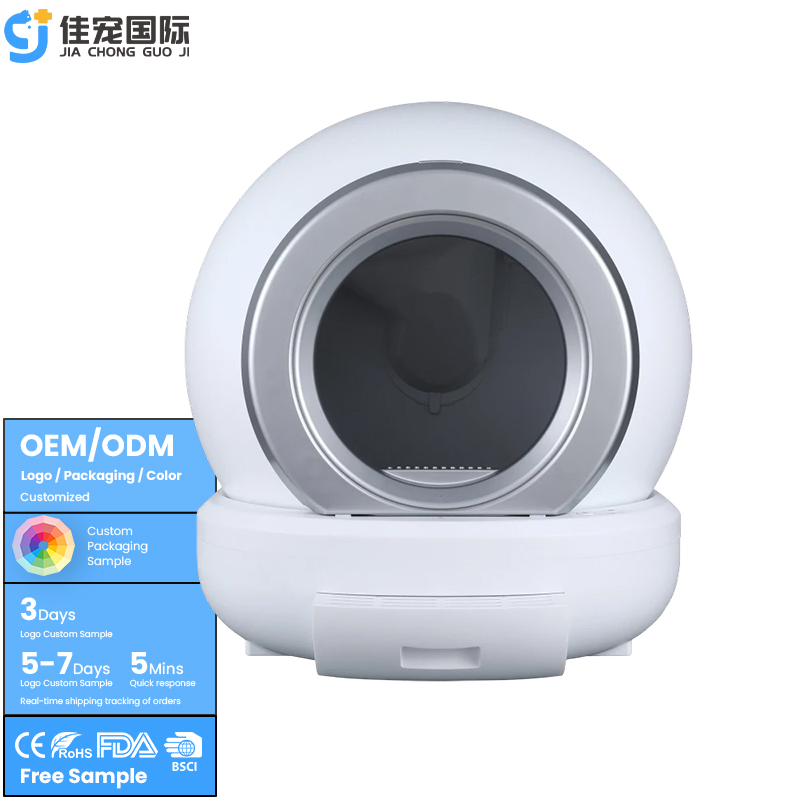 65L Automatic Cat Litter Box1. Automatic litter box scooping, freeing your hands.View Product →
The second structural decision is the entry. An enclosed drum wins on odour containment and litter tracking, because granules fall back inside the drum. The trade-off is that some cats refuse a small entry, and when a buyer has to spend two weeks on acclimatisation the reviews suffer. An open model removes that problem, at the cost of odour control that depends far more on filter design and how often the owner changes litter.
The table below puts three common specifications side by side so the choice can be made against the target market rather than against a catalogue.
| Model class | Structure | Typical household | Cleaning interval | Main sourcing trade-off |
|---|---|---|---|---|
| 65L automatic | Enclosed drum | Single-cat apartment | Roughly 5 to 7 days | Lower carton volume and freight; lower capacity ceiling |
| 76L automatic | Enclosed drum | Two or more cats | Roughly 7 to 10 days | Better interval, noticeably higher freight per unit |
| 76L open | Open tray | Cats that refuse enclosed entries | Depends on the waste tray | Higher acceptance rate; odour control needs a filter plan |
Intervals shift with litter type, humidity and the number of cats, so treat the figures as planning ranges rather than commitments. What matters commercially is that freight and packaging costs move with the class you choose, while the electronics bill of materials barely changes at all.
Cost Structure and Where the Tooling Money Goes
Once an FOB price arrives, it is worth breaking it apart. On a drum-type machine the mechanical assembly dominates, not the electronics. That single fact tells you where to negotiate: motor, gearbox and structural parts are the levers. Trimming a sensor saves very little money and raises the return rate.
- Mechanism and shell - 45%
- Electronics and firmware - 20%
- Tooling amortisation - 15%
- Packaging and freight - 12%
- Certification and QC - 8%
Tooling is the line item that most often stalls a programme. A new mould set for a medium-complexity litter box shell, including a rotating drum and a waste tray, commonly runs into five figures in US dollars once steel grade, cavity count and slider requirements are settled. The absolute number matters less than how it is spread. The same tool set carried across three thousand pilot units and across thirty thousand production units produces very different unit costs, which is why volume projections should be agreed before the mould order, not after.
This is also why extending a platform is cheaper than starting a second one. Once the control architecture and part of the mechanism are shared, the incremental investment sits mainly in shell tooling, packaging and documentation, so adding a second capacity class is rarely a doubling of engineering spend.
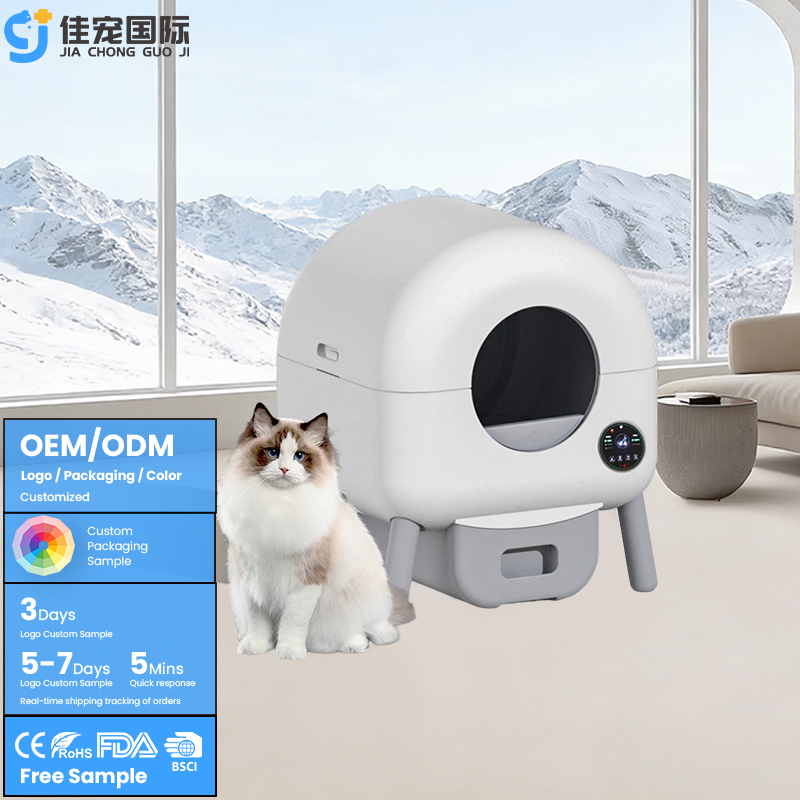 76L Automatic Cat Litter Box1. Two working modes: Manual and Automatic.View Product →
A Realistic Timeline from Specification to Mass Production
A new cat litter box programme normally needs about twenty to twenty-four weeks from frozen specification to first shipment. Most of that is not design work. Tooling and certification consume the bulk of the calendar, and neither compresses easily, because steel preparation, heat treatment and trial shots follow their own physical cycle.
Certification is often the hidden critical path. Wireless modules force electromagnetic testing that can only be scheduled once the firmware is frozen, and firmware is frequently still changing during T2. The workable approach is to lock the radio module early and treat every later firmware change as a schedule event with a cost attached, rather than as a routine engineering adjustment.
- Freeze power, radio and mechanism specifications before tooling release
- Approve T1 for fit, T2 for function, and never combine the two
- Start certification paperwork in parallel with T2, not after it
- Run pilot production on the same line and mould that will serve the order
Quality Checkpoints That Should Hold for Every Batch
Inspection plans written after the first complaint are too late. The following checkpoints are worth naming in the supply agreement, because each one maps to a failure that has already been seen in the field.
- Incoming: sample motors, gearboxes and load cells per batch, recording no-load current and noise level against a reference value
- In-process: full-function no-load run and door lock test on every assembled drum
- Finished goods: AQL sampling with a continuous fifty-cycle run, logging jams and abnormal noise
- Safety functions: anti-pinch and overweight tests with calibrated weights, with retained samples per batch
- Packaging: drop and vibration testing to an ISTA level agreed in advance, especially for units with displays
- Documents: declaration of conformity, RoHS and REACH reports, instruction language versions, spare parts list
One practical detail: ask for the batch number to be marked on the rating label rather than only on the carton. When a defect appears eighteen months later, traceability back to a mould or component lot is what decides whether a recall is limited or total.
Sourcing Risks That Quietly Erase the Margin
Most of these do not appear on a price sheet until the second or third order.
- Firmware version not frozen. A sensor is substituted in batch three, behaviour differs from the sample approved in batch one, and reviews split into two contradictory groups.
- Open models specified to the lowest cost. Removing the carbon filter to save a small amount per unit produces odour complaints that cost far more in returns and marketplace ratings.
- Spare parts left out of the contract. Motors and control boards are wear and repair items, and buying them separately at a later date is usually far more expensive than listing them upfront.
- Capacity chosen without checking carton dimensions. A 76L unit occupies noticeably more cubic volume, and on a sea freight calculation that difference compounds across a container.
An open-format machine is a defensible product line when it is positioned honestly, with a filter plan and a stated cleaning routine, rather than sold purely as a cheaper alternative.
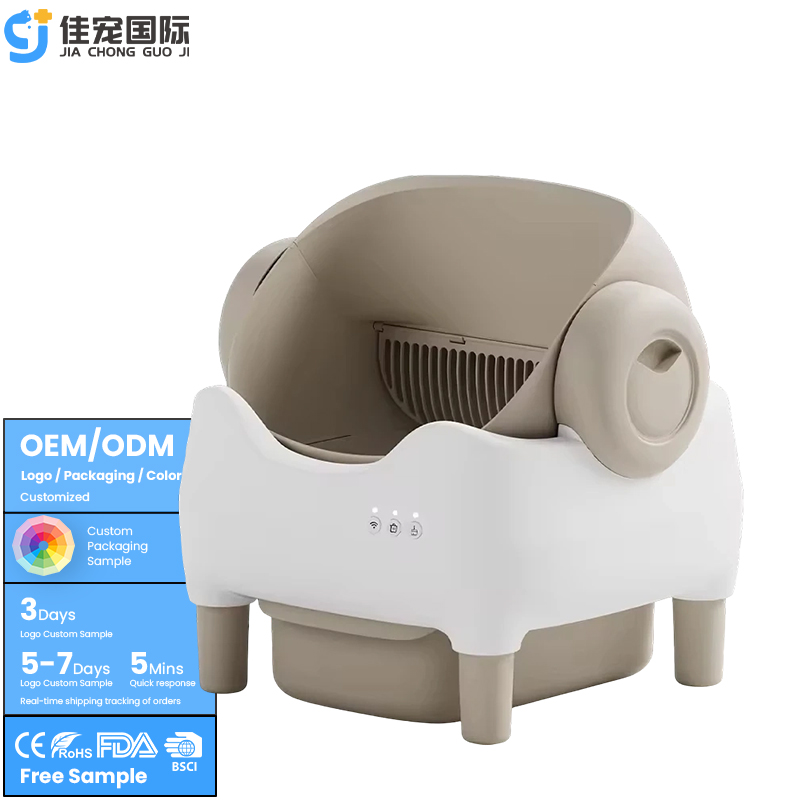 76L Open Automatic Cat Litter Box1. Two working modes: Manual and Automatic.View Product →
Frequently Asked Questions
What is the difference between OEM and ODM for a cat litter box?
OEM applies your brand to an existing mould and specification. ODM means the specification itself is developed in the project, covering structure, electronics, tooling and certification. Cost and lead time differ accordingly, and the ownership terms for the resulting design should be written into the contract.
Should a buyer order a sample before a bulk order?
Yes, and it should be produced on the production mould, not on a prototype tool. Sample approval is only meaningful if the unit you approve is built the same way as the units you will receive.
Can an ODM litter box carry private-label branding and custom appearance?
Branding, colour, packaging and instruction languages are routine. Appearance changes that affect the shell geometry require new mould work, so they should be decided before tooling release rather than after.
From what order volume does customisation become worthwhile?
It depends on tooling scope rather than a fixed number. The relevant calculation is total tooling cost divided by projected lifetime volume, compared against the price premium a differentiated model can command in your market.
Getting the Order Right the First Time
An ODM litter box programme is decided less by design flair than by discipline: specification, tooling, certification and spare parts written into one contract and one schedule. Two extra weeks spent settling parameters at the quotation stage routinely saves several months of rework later.
The contact page is the shortest route into a quotation, and it helps to arrive with the capacity class, entry structure and target certification already decided.















Since its founding in 2009, Jia Chong has devoted itself to the pet-care sector, with a “people-first, pet-embrace” philosophy, delivering professional, high-quality, full-line one-stop solutions for pet families worldwide.
-
 No. 90, Fengming Road, South District, Economic Open Zone, Yuyao City, Zhejiang Province, China
 -
 +86-152 5827 1677
-
 info@nbpetsfamily.com
Copyright © Ningbo Jia Chong International Trade Co., Ltd. All Rights Reserved. OEM/ODM Pet Accessories Manufacturer Pet Products Factory
